The 1980s AI Photo Prompt Chatgpt Trend: How It Works and What Nobody’s Warning You About
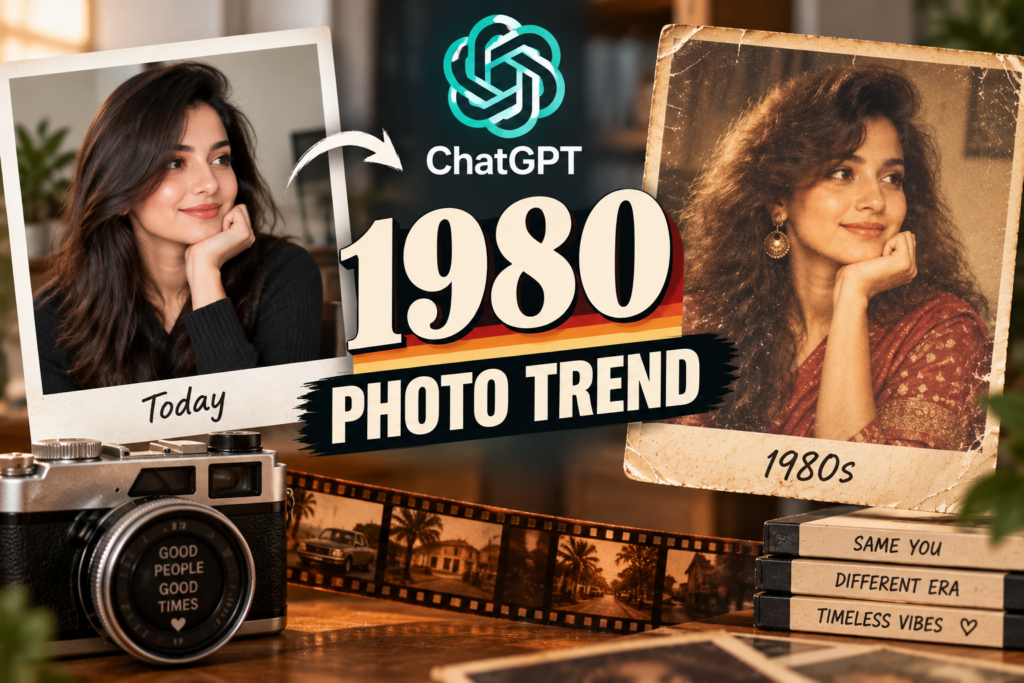
Illustration generated using AI to demonstrate how modern photos can be transformed into a nostalgic 1980s-style look. The people shown are AI-generated and are not real individuals.
Your feed didn’t get a filter update. It got a time machine. The 1980s AI photo prompt chatgpt trend has taken over Instagram and TikTok over the past week, transforming regular selfies into images that appear to have been taken directly out of a 1986 yearbook, complete with neon studio lighting, permed hair. Shoulder pads.
What Just Happened With the 1980s AI Photo Prompt Chatgpt Trend
The trend runs on one simple move: upload a clear photo of your face to ChatGPT, paste in a specific prompt, and get back a reimagined version of yourself styled for the decade of big hair and bigger jackets. It had its origins in interactive stickers used in Instagram Stories, then gained popularity as users added their outputs on top of “Add Yours” stickers and encouraged their friends to take the quiz. Since then, it has spread on Instagram feeds and Tik Toks around the whole Latin America as well as Brazil and India, with multiple thousands of posts under modified versions of the trend.
You upload a clear, straightforward, forward-facing shot. No sunglasses, no overwhelming filters. And an eighties photo prompt. You tell it to retain the face and the skeletal structure of your bones but to reconstruct everything else around that – thepermor volume of your hair, the denim jackets, the shoulder pads, studio neon lighting, and the grainy warm-filter look of 80’s film quality photographs.
Why the 1980s AI Photo Prompt Chatgpt Trend Feels Different
Retro photo filters have existed for years, and none of them caused this kind of reaction. The difference is that a filter just recolors your existing photo. A 1980s AI photo prompt chatgpt request actually rebuilds the scene — new hairstyle, new clothing, new lighting, new background — while trying to keep your actual face recognizable underneath it. That’s a much heavier lift than a color grade, and it’s only become convincing recently as image models got sharper at preserving facial identity through a full stylistic overhaul.
The fact it’s sitting within the context of chat as opposed to just a one-off-fun-filter app is also relevant. No preset ’80s’ button here; you are typing out (or cutting and pasting) an actual instruction, and because that is the case you have the opportunity to steer it toward a Bollywood studio portrait style, a ‘family album’ snap, or even a ‘magazine cover’ feel through subtle differences in how you word the prompt. Flexibility like that’s a key part of the reason why the results don’t feel as gimmicky as previous retro filters, and a reason why this kind of fad has lasted across such vastly different geographical locations and styles.

The Catch With the 1980s AI Photo Prompt Chatgpt Trend
Here’s the part getting skipped in most of the “here’s the prompt” posts: you’re uploading a clear, identifiable photo of your face to a third-party AI system to make this work. That’s a different privacy calculation than swiping a filter slider. Once you’ve handed over a sharp front-facing photo, you’re trusting that platform’s data handling — and the 1980s AI photo prompt chatgpt trend has also pulled in a wave of copycat apps and websites promising instant results, some of which are far less transparent about what happens to the images you upload than ChatGPT itself.
There’s a second wrinkle: the “Add Yours” mechanic that helped this trend spread also means your generated portrait — and the original photo behind it — can end up circulating well beyond your own followers. Once someone reshares your result, you’ve lost control of where that image travels.
Practical Impact: Using the 1980s AI Photo Prompt Chatgpt Trend
Getting a Good Result From the 1980s AI Photo Prompt Chatgpt
- Use a real photo you’re fine with an AI processing. Don’t use a photo of someone else without asking them first — the trend only needs your face, not theirs.
- Write the prompt yourself instead of copy-pasting blindly. Specify what should stay the same (face, skin tone, features) and what should change (hair, outfit, lighting) — vague prompts produce results that drift further from your actual face.
Staying Safe With the 1980s AI Photo Prompt Chatgpt
- Skip the copycat apps. If you’re doing the 1980s photo trend with ChatGPT, stick with the platform directly rather than a random app riding the same wave with unclear data practices.
- Check what happens to the photo after. If you’re a freelancer or creator building a personal brand around your image, know whether the platform retains your uploads before you make this a regular habit.
- Treat the output as a fun approximation, not an accurate transformation. These results are stylized guesses, not a real record of anything.
Bottom Line on the 1980s AI Photo Prompt Chatgpt Trend
The 1980s AI photo prompt chatgpt trend is a genuinely fun use of image generation, and it’s not going anywhere this week. But the appeal — hand over your face, get back a convincing alternate-decade version of yourself — is exactly what makes the privacy side worth a second thought before you jump in. Enjoy the perm and the neon lighting. Just know what you’re trading for it.
Don’t Miss: ChatGPT Astra 6 Launch Will Shock You: OpenAI’s Biggest AI Upgrade Yet


