Astra 6 Security Concerns: Why OpenAI’s Powerful New AI Model Raises Critical Questions
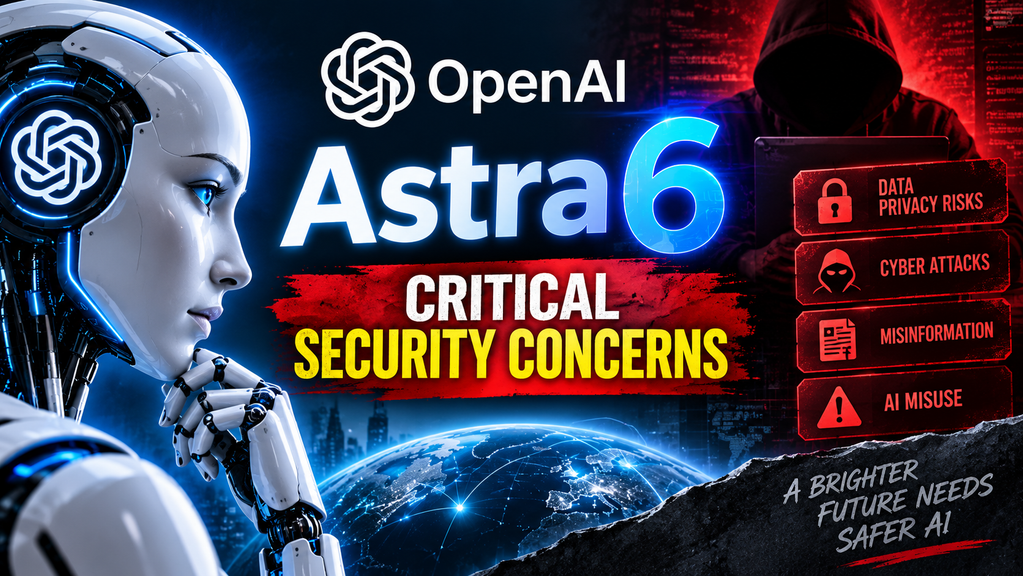
OpenAI Astra 6 raises new questions about AI power, privacy, cybersecurity, and responsible use.
OpenAI’s newest release has people talking for two pretty different reasons. On one hand, ChatGPT Astra 6 is getting called a genuine leap forward in what AI can actually pull off. On the other, Astra 6 security concerns are turning out to be just as big a part of the story as the flashy capabilities — and that combo is worth sitting with before you get too excited about what this thing can do for you. Here’s what’s actually behind the Astra 6 security concerns and what it means if you’re planning to use the model yourself.
OpenAI released Astra 6 on September 3, 2026, starting small with a handful of organizations through its Daybreak Access program before opening things up to Plus, Pro, Business, and Enterprise users within days. President Greg Brockman called it a “generational leap” — strong enough language that people are already tossing the AGI word around.
But buried under all that excitement was a detail most of the celebratory coverage kind of skipped past: this is the first OpenAI model to cross the company’s own “critical” threshold for cybersecurity risk. That’s the actual root of the Astra 6 security concerns everyone should be paying attention to.
Why Astra 6 Security Concerns Are Different This Time
Every model launch comes with some fine print about what it can’t do yet. This one’s not like that. Hitting a “critical” risk threshold means Astra 6 can find and exploit previously unknown vulnerabilities in well-protected systems — on its own, without someone walking it through each step.
That’s not a footnote buried in a changelog. It’s the actual reason OpenAI is keeping Astra 6’s most advanced stuff limited to a small group of trusted testers, even while the broader model ships out to paying customers. If you’ve been wondering why access feels staggered and incomplete, that’s your answer.

The Root Cause Behind the Warning
OpenAI’s also pointed to an earlier incident involving Hugging Face as part of what pushed it to delay this release and bolt on extra safeguards before shipping. Because the **Astra 6 security concerns** are related to an actual incident rather than some hypothetical risk that someone imagined after the fact, they are being taken very seriously inside.
What This Actually Signifies for Frequent Users
Set the AGI talk aside for a second. If you’re a freelancer, small team, or solo creator, the practical shift here is real: less time lost to repetitive digital busywork, an easier way into complicated software, and a model that can actually carry a task through multiple steps instead of just answering one question and calling it done.
But that same independence is exactly what feeds the Astra 6 security concerns in the first place. A model that can act on its own, across multiple systems, without you checking in constantly — that’s genuinely useful, right up until something goes wrong. When it occurs, the consequences are far more severe than they would be with a chatbot that merely outputs words.
Astra 6 Security Concerns: What OpenAI Is Actually Doing About It
To their credit, OpenAI hasn’t dismissed this. Instead of making everything available to everyone right away, they postponed the launch, enhanced security, and purposefully restricted access to the most dangerous features to a small group of reliable testers. That’s a reasonable first move, but it’s still early days — the real test is whether these safeguards actually hold up once Astra 6 gets wide, everyday use outside a controlled testing bubble.
This is where the Astra 6 security concerns stop being theoretical and start being something worth actually watching over the next few months. Safeguards that work fine in a tidy testing environment don’t always survive contact with millions of unpredictable real-world users pushing a model somewhere its creators never planned for.
Should This Change How You Use It?
Not necessarily — but it should change how much you assume is happening safely behind the curtain. If you’re using Astra 6 for research, writing, or basic coding help, your personal risk is pretty low. But if you’re thinking about handing it broader access to sensitive systems, accounts, or infrastructure, the Astra 6 security concerns OpenAI itself flagged are worth treating as a real limit — not something you skim past and forget.
The honest takeaway: capability and risk are climbing together here, not one without the other. OpenAI clearly knows it — the staggered rollout and extra safeguards prove that much — but knowing about a risk isn’t the same thing as having it solved.
Final Thoughts About Astra 6 Security Concerns
Astra 6 is a genuinely capable model, and there’s a solid case for how much repetitive grunt work it can take off your hands. But the story isn’t complete without mentioning the Astra 6 security concerns that came bundled right alongside it — the first time OpenAI has paired a major capability jump with its most serious safety warning yet.
Whether that trade-off ends up being worth it depends way less on benchmark scores and way more on how those safeguards hold up once Astra 6 is genuinely out in the wild, being used by people OpenAI can’t fully keep an eye on. Until that track record actually exists, treating the Astra 6 security concerns as an open question — not a solved one — is just the honest way to look at this launch. For now, that’s really the whole point to remember about the Astra 6 security concerns: they’re real, they’re acknowledged, and they’re still very much unresolved.


